


Apr. 1, 2026
Bridging the humanities and informatics through music
Shintaro Seki, JSPS PD Researcher
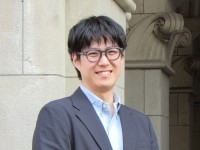
Please describe your current research.
I develop methods to make historical documents related to gagaku—a traditional Japanese court music genre—machine-readable. In practice, this means converting ancient scores into digital formats that computers can analyze. While Western music benefits from well-established digital standards based on the five-line staff, many non-Western traditions remain difficult to process computationally.
By designing encoding methods tailored to gagaku’s unique notation and performance practices, I aim to broaden the scope of computational musicology and help preserve and access diverse musical heritages in the digital age.
How did you become interested in this field?
I have played the piano since childhood, but a turning point came when I encountered J. S. Bach’s Schafe können sicher weiden (“Sheep may safely graze”) and had the chance to play it myself. Originally part of a secular cantata, the piece later became widely known through Egon Petri’s piano arrangement and Leon Fleisher’s comeback album "Two Hands". In Japan, it was also familiar as the opening theme of a long-running NHK radio program.
Seeing how one composition could move across centuries, formats, and cultural contexts made me aware of music as a living continuum. I became interested not only in performance, but also in how music is transmitted, transformed, and preserved over time. That realization eventually led me to combine musicology with informatics.
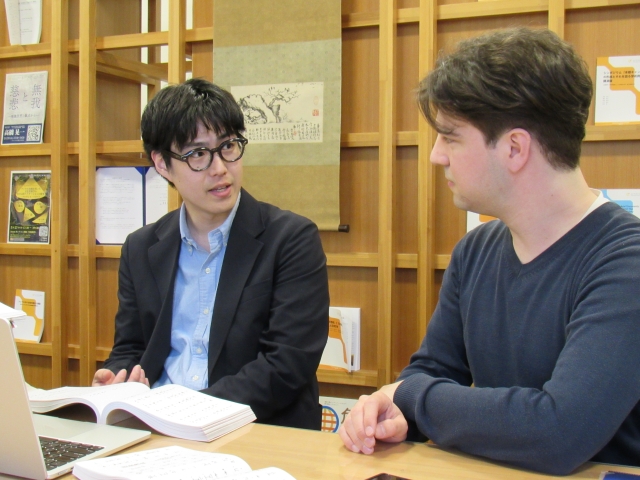
Shintaro Seki had a discussion with Tamas Nemes from ETH Zurich.
What excites you most about your research, and what is challenging about it?
What excites me most is working in an area that remains largely unexplored. Although gagaku has a history of over a thousand years, computational approaches to it are still rare. This means I often have to build methods from the ground up. While the lack of prior research can be demanding, it also offers intellectual freedom and the opportunity to define new directions.
The main challenge is balancing technical development with cultural understanding. Japanese traditional music relies heavily on oral transmission, and written scores often contain limited information. To interpret them accurately, I consult instructional texts and listen carefully to performances. Bridging informatics and musicology requires time, patience, and sensitivity to both fields.
What led you to become a researcher, and how did you join RIKEN?
There was no single decisive moment. As an undergraduate, I attended graduate-level seminars and observed discussions among master’s and doctoral students. Being surrounded by researchers made academia feel like a natural path. The supportive atmosphere of my graduate laboratory further encouraged me to continue.
After earning my PhD from the University of Tokyo in March 2025, I joined RIKEN as a JSPS Postdoctoral Fellow. Although my doctoral work involved computational approaches, I had been based in a humanities environment. I chose RIKEN to challenge myself in a leading research institute known primarily for the natural sciences and to deepen my interdisciplinary work in a new setting.
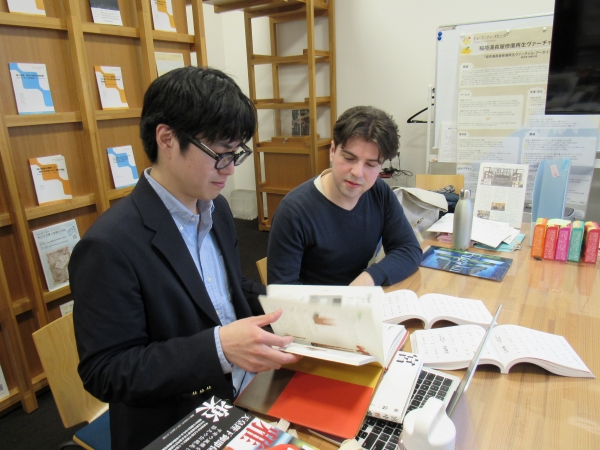
Shintaro Seki and Tamas Nemes reading gagaku score.
What is it like working at RIKEN?
RIKEN provides an environment where I can concentrate fully on research. The availability of strong computational resources gives me confidence that I will be able to conduct large-scale analyses as my dataset expands.
Coming from the humanities, I am especially struck by the scale of projects and collaborations. Observing large research teams has helped me envision how to develop my own work through interdisciplinary partnerships. Being a humanities researcher within a major science institute also highlights the distinctive value of my cross-disciplinary approach.
What are your goals, and what advice would you give to young researchers?
My goal is to bridge the humanities and informatics through music. By connecting cultural knowledge with computational methods, I hope to contribute to a richer understanding and preservation of musical traditions.
To young researchers, I would say: stay curious beyond your immediate field. Opportunities often emerge unexpectedly—I learned about the possibility of conducting music research at RIKEN through an international conference. Keep an open mind, explore related areas, and do not hesitate to step into new environments when something sparks your interest.
Rate this article