


May 25, 2026
Focused ion beam engineering for next-generation quantum devices
Max Birch, Research Scientist
Please describe your current research.
My research focuses on finding ways to turn newly discovered quantum materials into working devices. Many of these materials show remarkable properties that could be useful for future technologies, but they are usually first made as large crystals – not in forms that are easy to use in electronics. I use a focused ion beam, a highly precise tool that can cut and shape those crystals directly into tiny devices. This allows us to explore devices made from promising materials much more quickly than we would be able to with conventional methods. In the long term, this could help accelerate the development of new technologies based on quantum materials.
How did you become interested in your current field of research?
I became interested in this field through hands-on experience. While working on my PhD, I spent a great deal of time learning to use the focused ion beam to make devices for x-ray microscopy studies of magnetic materials, and over time, I developed a high level of skill with the technique. After coming to RIKEN, I was exposed to a much wider range of quantum materials and research questions, and I began to see that the focused ion beam could be useful far beyond the projects I had worked on before. That was the moment I realized this could become a much broader research direction. I am especially grateful to my supervisor, Prof. Yoshinori Tokura, for encouraging me to explore that possibility.
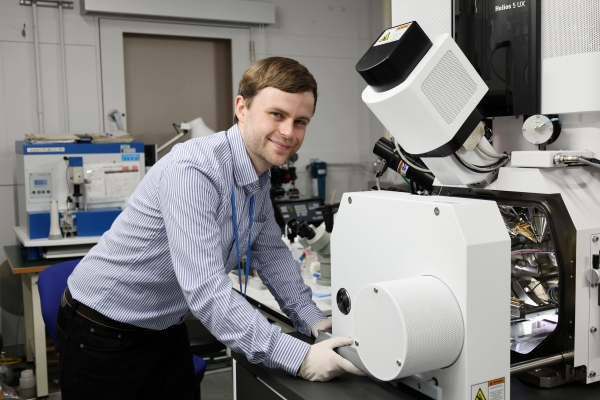
Max Birch with a focused ion beam instrument.
What excites you the most about your current research?
What excites me most is the chance to create entirely new kinds of devices that were not previously possible. I recently developed a method for fabricating tiny three-dimensional structures from quantum materials, including complex shapes such as microscale helices1. This allows us to go beyond simply studying a material as it naturally exists and instead design new geometries that can change its behavior. For example, by shaping a magnetic quantum material into a helix, I was able to realise a device which showed new electronic functionality which the original material would not show on its own. Specifically, a diode-like response, which could be reversed by switching the magnetisation direction of the material.
What made you decide to become a scientist?
I became a scientist because physics fascinated me from an early age and inspired me to explore the fundamental laws of the universe. Today, I’m motivated by the opportunity to design original experiments and make new discoveries, especially in materials science, where even small teams can achieve meaningful breakthroughs.
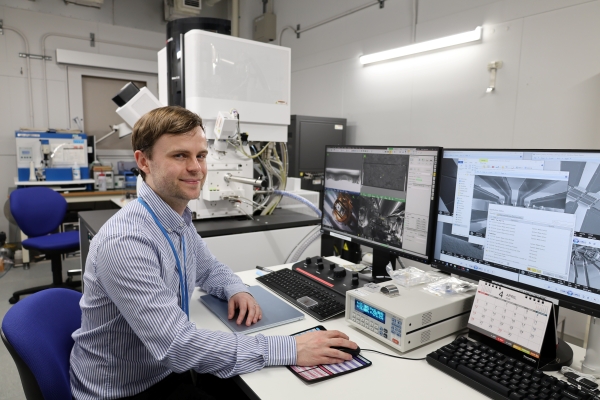
Max Birch operating the focused ion beam instrument to fabricate a device.
When did you join RIKEN?
I first joined RIKEN in 2017, when I had the opportunity to visit for three months through the JSPS Summer Program while I was still working on my PhD. My research at the time focused on magnetic skyrmions, and RIKEN CEMS was already one of the world’s leading centers in this field. During my stay, I learned a great deal and was deeply impressed by the research environment. After that experience, I hoped to return one day, so I was very happy and honored to later have the opportunity to return as a Special Postdoctoral Researcher in 2022.
What is the best thing about working at RIKEN?
The best thing about working at RIKEN is being part of a research center where many people work on closely related scientific questions from different angles. At CEMS, this creates a very stimulating environment because there is a broad range of expertise across quantum materials and many opportunities to exchange ideas. It also means the shared research facilities are exceptionally strong, because so many researchers rely on advanced equipment. This environment has helped my research enormously by exposing me to topics I might never have explored otherwise. It has encouraged me to think more broadly and to work with many different materials, rather than staying within one research area.
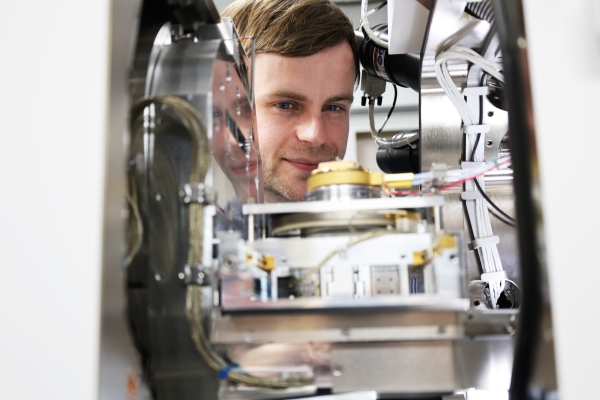
Max Birch loading a sample into the focused ion beam instrument.
What has been your most memorable experience at RIKEN so far?
My most memorable experience so far has been writing my first research article at RIKEN2. It was a formative moment for me because I had the opportunity to work closely with my supervisor, Prof. Yoshinori Tokura, and our collaborator, Prof. Naoto Nagaosa, as we interpreted the data and developed the paper. As preeminent researchers in condensed matter physics, their guidance is an extraordinary privilege and has had a lasting impact on me. In particular, it taught me how to think more deeply about the meaning of experimental results, and how best to communicate those ideas in the form of the paper.
Message to young researchers and students.
My advice would be to strive to be both creative and rigorous. Good research often begins with the courage to ask new and imaginative questions and explore ideas that may seem unusual at first. But it is equally important to examine your results carefully, question your assumptions, and stay grounded in evidence.
References
- 1.Sculpting complex, 3D nanostructures with a focused ion beam
- 2.The motion of magnetic whirlpools is all relative
Rate this article