


Aug. 3, 2026
Making quantum computers in which atoms “speak” with each other
Sylvain de Leseleuc, Team Director
Please describe your current research.
In my lab, we trap and manipulate individual atoms using lasers, and with them, develop quantum technology and explore fundamental physics. One of our ongoing projects is to build a quantum computer based on atoms. For this, we have to make atoms “speak” to each other in an exquisitely precise manner by exciting one of their electrons to orbits that are thousands of times larger than usual. I hope that the quantum technology we are developing in my team, and more generally at RIKEN Center for Quantum Computing (RQC), will become an integral part of the technology that we use in the future, which will be needed to support our changing society. For example, we expect that quantum technology will be the basis for solving problems, like drug discovery, which remains very hard even with powerful supercomputers or AI. I also hope that in parallel with the development of the quantum computer, we can use the very precise tools that we invent for making fundamental discoveries in physics: such as why there is more matter than antimatter in our universe. In addition, I hope to contribute to the cold-atom quantum computing community in Japan. Currently, I am driving a JST ASPIRE community program, where we create connections and exchange with researchers in Germany, and I also participate in the Moonshot research program.
How did you become interested in your current field of research?
So many people have contributed to my passion for science. My parents stimulated me by bringing me to science museums and subscribing to science magazines (like Newton in Japan). Then, at school and universities, I had several fabulous mathematics and physics teachers who kept me fascinated about the fundamental bricks of our world and how to describe them. This led me to join laboratories and explore physics by myself, where I was very lucky to find mentors who guided me into becoming the researcher that I am now.
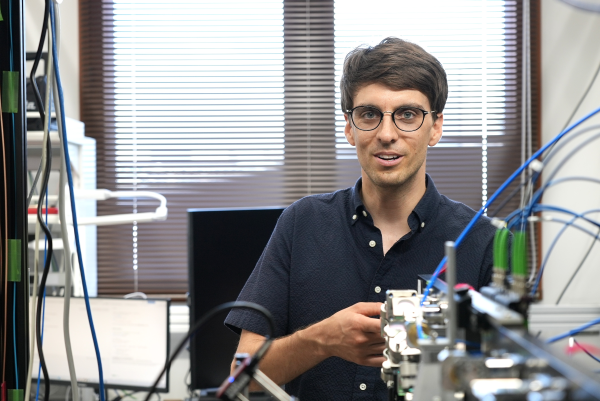
Sylvain de Leseleuc with an experimental setup based on atoms trapped in an array of optical tweezers.
What excites you the most about your current research?
It is a very quickly growing field. When I started my PhD in 2015, there were a handful of research groups doing this manipulation of individual atoms for quantum computing. Now there are hundreds of teams worldwide, each of us testing new ideas and inventing novel tricks at a very fast pace. I am lucky to have joined this adventure at a time where I can contribute to the development of quantum computers and really shape the direction of this field.
How and when did you join RIKEN? Why?
I love exploring physics with my colleagues and students, so I first considered joining RIKEN just after earning my PhD in 2019. At the time, I thought I might apply to RIKEN’s SPDR program and work as a postdoctoral researcher. In the end, I decided to pursue another exciting opportunity in Japan at the National Institute of Natural Sciences (NINS), where I was offered an Assistant Professor position and started gathering and training researchers and students. This was an amazing experience, but it was not a permanent position. In 2023, when the newly launched RIKEN Center for Quantum Computing was looking for a Team Director to establish a group with expertise in atom-based quantum computers, I knew it was the perfect time and place.
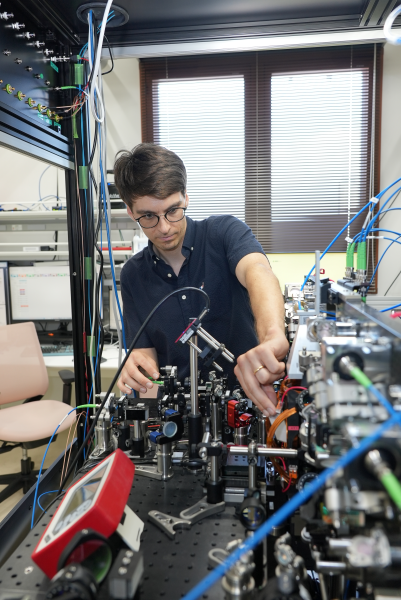
Sylvain de Leseleuc operating the setup.
What is the best thing about working at RIKEN?
The support for research is truly incredible. As a Team Director, there is a lot to organize so that your team can do the actual research. From day one I was immediately supported by the center administration and my administrative assistant. With them, I was able to smoothly learn how to grow my team (we are now about 10 people after 2 years) and give them the tools to do research at a competitive international level.
Another key aspect is the rich research community here. I collaborate daily with two or three teams, and together we can make projects that would have been impossible to investigate alone. I can enjoy many seminars and events where I learn new physics and meet people that stimulate and inspire my research.
What are some of the techniques and technologies that you use to conduct your research?
I use many lasers and optical systems to manipulate atoms. Some of our use cases for the laser systems are so demanding that we cannot buy them from manufacturers, but have to develop and build them ourselves. I can then directly optimize their performance for the exact metrics that matter for us.
What has been your most memorable experience at RIKEN?
I was appointed in June 2024, at a time where I was already supervising more than 10 researchers and students in NINS. I knew it would take some time until I could bring my team in RIKEN up to the same level of activity. Fast forward two years and … we did it! And it is such a pleasure to walk around the offices and laboratories every day and discuss ongoing research activities with each member of my team. I love sitting in a corner of the lab with my laptop, working on my emails and enjoying the view of their frenetic activity.
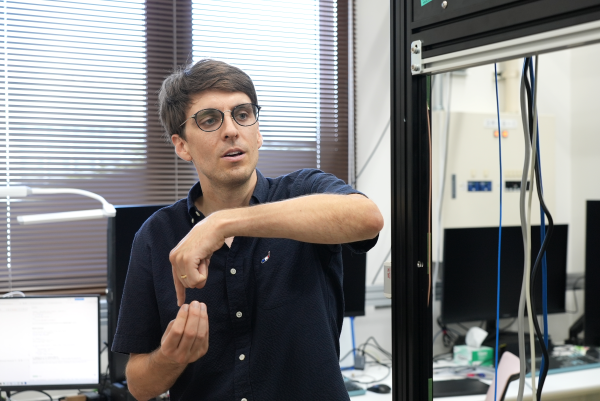
Sylvain de Leseleuc explaining the mechanism of cold atoms and why the atoms "speak with each other".
What surprised you most about working or living in Japan?
Oh, I got surprised by Japan when I first visited in 2012 and then for my master thesis work at the University of Tokyo in 2014. Japan is where my whole professional life has been since I completed my PhD, so, the Japan way is the standard for me now! But, I will say that one of the first differences I noticed was communication style, or maybe how the time and place for certain types of communication differs from how we do it in France. For example, in France, people talk a lot about anything during the lunch break and during (many) coffee breaks. I learned that in Japan, people usually have those kinds of conversations after work while drinking.
Please tell us about your goals.
I want to see my team enjoying doing physics as much as I did when it was my turn to be in the laboratory! With them, I want to fascinate the world with beautiful experiments showing the nature of the quantum world. On a personal level, I want to continue discovering beautiful natural landscapes in Japan and learning about Japan’s history. For the history, I watch the Taiga drama series that’s broadcast on NHK! For those who don’t know, each year-long drama focuses on historical figures and pivotal moments in Japanese history. It’s very interesting and educational, and I am a big fan. I also love the super short asadora morning dramas that NHK shows on weekdays.
What advice would you give to young researchers / students who want to work at RIKEN?
First I just want to let people know that RIKEN is an amazing place where you will be stimulated and excited about science. Come learn and discover with others what the quantum world can do for our society! Research is not only about doing the hard work in the laboratory. In fact, maybe the most important part is to share ideas and have discussions with your labmates and other colleagues. This is especially true at RIKEN where there are many opportunities for having these kinds of interactions, if you take some initiative. So, let’s create and seize every opportunity to do so!
References
Rate this article