


Mar. 11, 2026
How plants deal with stress
Amelie Ducloy, Special Postdoctoral Researcher

Describe your role at RIKEN.
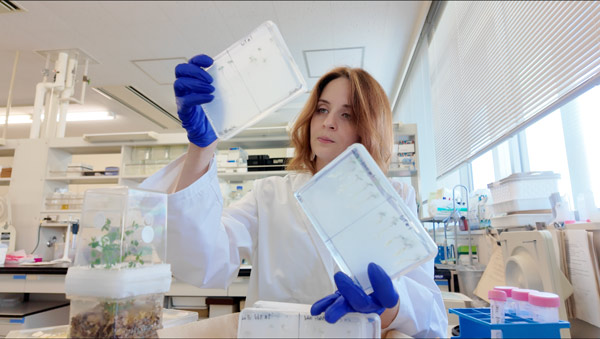
I study the stress response of the plant endoplasmic reticulum (ER), a network of membranes involved in protein synthesis and lipid metabolism. When plants are exposed to heat stress, errors occur during protein synthesis, folding and maturation, leading to the accumulation of toxic misfolded proteins in the ER. Misfolded protein accumulation induces ER stress, which can threaten the plant’s survival. This activates mechanisms to eliminate abnormal proteins and increase ER protein folding capacity, thereby alleviating the stress.
Briefly describe your research.
In a 2022 study in France, I induced misfolded protein accumulation in the ER of plants using a specific antibiotic instead of heat stress and analyzed which genes were expressed. I discovered that ER stress affects the lipid composition not only of the ER membrane, but also others such as the plasma membrane.
How did you become interested in this field?
My passion for living organisms began in childhood. In high school science class, I learned about DNA and was particularly struck by restriction enzymes—proteins that recognize and cut specific DNA sequences. I was amazed. How could enzymes do something so precise? That moment inspired me to become a biological researcher.
Plants cannot move in the same way as animals, which is why they’ve evolved sophisticated defense mechanisms against environmental stress. That’s what makes them so fascinating to me.
When did you join RIKEN?
While conducting research in France, I learned that Japan is a global leader in ER stress response research. A colleague who worked at RIKEN introduced me to its outstanding research environment and high academic standards. This motivated me to apply for a job.
In December 2022, my husband—who majored in physics—and I moved to Japan after he also secured a research position.
How do you balance family life with your work at RIKEN?
My husband and I are extremely happy with our life in Japan, and we both hope to continue working here. I enjoy exploring traditional crafts in Kanazawa, such as gold leaf and Kaga Mizuhiki (tying decorative knots with paper cords) and temari (making embroidered balls) and visiting workshops for kimono dyeing. In Tokyo, I love Ueno for its pond, museums and art galleries. I’m also a big fan of Japanese cuisine and enjoy cooking it myself. A recent find has been a duck-and-green-onion ramen shop in Ueno, Tokyo. On my days off, I try not to think about research but rather I try to appreciate beauty as I find it without thinking too much about it.
My research is important for society because…
France is a leading European agricultural producer and Japan is at the forefront of ER stress research. I hope my work can help address food security challenges in both countries.
Meet a rising star at RIKEN vol. 3 | Interview with Amelie Ducloy (full)
Rate this article