


RIKEN Early Career Leaders (ECL) Program FAQs
Last updated April 28, 2026
Basic eligibility
- Q1: What research fields are eligible for the ECL Program? Do you accept applicants who conduct research in the humanities or social sciences?
- A1: The eligible research fields are as follows:
- Mathematical Sciences (pure mathematics, applied mathematics, computer science, information science, artificial intelligence, etc.)
- Physics I (particle, nuclear, astrophysics, etc.)
- Physics II (condensed matter, etc.)
- Chemistry
- Life Sciences
- Engineering
- Humanities and Social Sciences (those which border/blend elements of the above fields)
Humanities or social sciences researchers are welcome to apply for the program.
- Q2: How many people are accepted each year for the ECL Program?
- A2: A specific number is not set. Successful candidates are chosen from a holistic perspective, based on an overall review of their application.
Qualifications
- Q3: Are there any age restrictions for the ECL Program?
- A3: The program is targeted at junior researchers with no prior PI experience or limited PI experience, but there is no age limit for the program. Similarly, there is no restriction based on the number of years that have passed since obtaining a PhD.
- Q4: Can I re-apply after a previous rejection?
- A4: Yes.
- Q5: Can I apply even though I currently live outside of Japan?
- A5: Yes, but if accepted, your work location will be at a RIKEN campus in Japan. It is not possible to engage in telework at RIKEN while living overseas.
- Q6: Currently, I am affiliated with RIKEN as a fixed-term employee. Can I apply for the ECL Program? If I get a position with the ECL Program, my total term of employment with RIKEN as fixed-term employee will exceed 10 years during my ECL Program term. When that happens, can I request to change my employment status to become an indefinite-term employee?
- A6: Current fixed-term employees at RIKEN can apply for the ECL Program. If you obtain and exercise the right to change your employment status to become an indefinite-term employee during your ECL Program term, you will be able to become an indefinite-term employee. After your ECL Program term ends, you will be hired as an indefinite-term Research Scientist, in accordance with RIKEN regulations.
- Q7: Can I also work at another organization while employed via the ECL Program?
- A7: In principle, ECL Program employees work at RIKEN full-time, but please contact us if you wish to arrange a cross-appointment or similar. Side work is permitted at RIKEN if approval is obtained after carrying out the required internal procedures. “Side work” refers to any work other than RIKEN work, such as running your own business or carrying out work for another organization (whether nonprofit or for-profit). Examples include lecturing at universities as a visiting lecturer or professor, working as an employee or executive of a RIKEN venture company, serving as a committee member, and speaking at conferences (when not part of your RIKEN duties).
Research expenses
- Q8: How is the research budget decided?
- A8: Research budgets are determined by the progress of your research plan. Each fiscal year, it is possible to apply for more or less than the average budget. RIKEN provides flexible budget support based on the situation.
- Q9: In the application, what should be included in the research budget plan?
- A9: Please include all necessary expenses, aside from your own salary. Necessary expenses include salaries for lab staff as well as equipment costs, etc. Depending on the field and the research plan, there may be high initial costs for setting up your lab. In such a case, please indicate these setup costs separately in your application, as RIKEN may provide additional funding for setup costs in addition to the yearly research budget.
- Q10: Which expenses should be included as part of the research budget, and which expenses should be included as part of the setup costs?
- A10: Expenses to be covered by the research budget include equipment and consumables, certain large-scale equipment (for exclusive use), lab staff salaries (excluding your own salary), travel expenses, and conference expenses.
Items to be included in the setup costs include large-scale equipment (for shared use, in principle) and construction costs associated with setting up the lab (e.g., installation of laboratory tables, office space preparation, and installation/adjustment of HVAC systems and plumbing). However, regarding construction costs associated with setting up the laboratory, please list the necessary construction tasks only; there is no need to include costs in your application.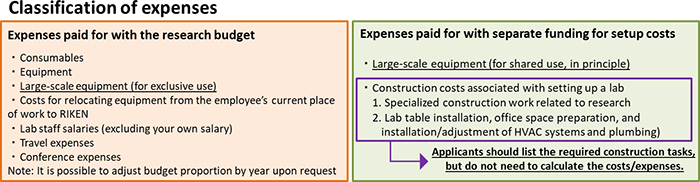
- Q11: I am unsure whether the large-scale equipment that I wish to use is available as shared equipment at the center where I hope to conduct my research. Should I allocate the equipment’s cost to the research budget or the setup costs?
- A11: If it is acceptable to make newly procured equipment available for shared use after purchase, please note this information and allocate the equipment cost to setup costs. Please note that if similar equipment to that listed is already available at the center, you will be asked to use the existing shared equipment. If you wish to have exclusive use of the equipment, please allocate the cost to the research budget. Note also that the annual research budget may be adjusted on a sliding scale to allow you to receive a larger or smaller portion of the total research budget at different stages of the project (for instance, when setting up your lab) to enable the flexible and timely use of funds.
As part of RIKEN’s 5th Mid- to Long-term Plan, and in order to meet national and societal needs, RIKEN is expanding access to our shared-use research equipment and facilities, as well as technical support, beyond RIKEN’s own researchers to include researchers affiliated with external organizations. - Q12: What is the approximate cost of staffing at RIKEN? I imagine that the expenses associated with hiring staff are higher than just their salary alone. What other specific expenses should be factored into the total personnel costs?
- A12: To cover the cost of social insurance and other expenses, please calculate personnel costs for each staff member as 1.3 times their annual salary amount.
Salary for fixed-term research employees at RIKEN is calculated as an annual amount (paid monthly), and consists of two components: a fixed salary and a variable salary. The variable salary is adjusted each year, and is based on each employee’s achievements, ability, attitude, and work performance.
As an example, as of April 1, 2026, at time of hire the total amount paid per month (including salary as well as discretionary work allowance) is 448,990 yen or more for a Research Scientist and 384,000 yen or more for a Postdoctoral Researcher.
However, please note that fixed salary and variable salary are subject to change in accordance with any revisions to RIKEN regulations.
Please note that end-of-term bonuses are not provided.
Please refer to the salary estimates shown in the job listings on RIKEN’s Job Openings page. - Q13: Are there any restrictions on applying for competitive funding?
- A13: RIKEN does not have any rules against applying for competitive funding, but funding organizations may have certain conditions or restrictions in place, so be sure to check these conditions. ECL Team/Unit Leaders are also eligible to apply for MEXT Grants-in-Aid for Scientific Research (KAKENHI), and in addition are eligible for an exemption from repayment for category 1 scholarship loans that were provided by the Japan Student Services Organization before FY 2003.
Allowances and other benefits
- Q14: Are commuting allowance, housing allowance, family allowance and end-of-term bonuses provided to ECL Team/Unit Leaders?
- A14: Commuting allowance, housing allowance and family allowance are provided. However, end-of-term bonuses and retirement allowance are not provided for these positions, to which the annual salary system applies. Late-night work allowance is also provided.
- Q15: Are relocation expenses provided?
- A15: Yes, in accordance with RIKEN regulations.
- Q16: As an ECL Team/Unit Leader, would I be able to take childcare leave? How would my term of employment be affected if I take childcare leave?
- A16: You are able to take childcare leave. If you take childbirth or childcare leave, your employment period may be extended by the length of time equal to the duration of leave.
There are various types of leave and support programs available to employees of all genders, with varying durations. For details of support systems related to pregnancy, childbirth, and childcare, please refer to the link below.
Support for balancing work and childcare
For an overview of RIKEN’s support for balancing work and childcare or family nursing care, please refer to the link below.
Diversity Promotion Section website: Support systems and benefits - Q17: How does health insurance work at RIKEN?
- A17: RIKEN is a member of the Science and Technology Health Insurance Society, which offers some additional benefits compared to the standard Japanese national health insurance. This health insurance provides coverage for all medical care services necessary to treat illness and injury, including dental and vision. The insurance pays 70% of the total medical cost, so users are charged only 30% of the total. In addition, copayments for medical care costs are capped. If your copayment calculated based on certain standards exceeds the maximum, the excess amount will be paid as “High-Cost Medical Care Benefits.” For details, please refer to the link below.
Health insurance and other services
Application procedures
- Q18: Should the application and the letters of recommendation be written in English or in Japanese?
- A18: All application documents, including letters of recommendation, should be in English.
- Q19: Do I need to submit my documents in black and white?
- A19: Documents may be in black and white or in color.
- Q20: Can I apply for both the ECL Team Leader position and ECL Unit Leader position at once?
- A20: No. Please select one of the position types for your application. During the selection process, if it is suggested that the other position type may be more suitable, with your consent, your application may be considered for that position.
- Q21: Is it possible to apply for other positions within RIKEN, such as Special Postdoctoral Researcher, while applying for a position with the ECL Program?
- A21: Yes.
- Q22: Is there a set format for research proposals and other application documents?
- A22: There is no set format for the application and letters of recommendation, as long as they are in PDF format. Please note that your research proposal must include an estimated budget, staffing plans, setup costs, and required space (in m²) for your lab.
- Q23: How many centers can I select when applying for the RIKEN ECL Team / Unit Leader position?
- A23: Please select one center from the list "Host center candidates for RIKEN ECL Team/Unit Leader" and indicate it during pre-registration. Please note that during the selection process, if it is suggested that another center may be more appropriate for your research based on the content of your proposal, with your consent, your application may be considered for that research center (including its location).
- Q24: How many research fields can I select?
- A24: You can select up to two of the following fields:
- Mathematical Sciences (pure mathematics, applied mathematics, computer science, information science, artificial intelligence, etc.)
- Physics I (particle, nuclear, astrophysics, etc.)
- Physics II (condensed matter, etc.)
- Chemistry
- Life Sciences
- Engineering
- Humanities and Social Sciences (those which border/blend elements of the above fields)
- Q25: I uploaded my research plan but realized I made a mistake. Is it possible to correct it?
- A25: You may correct your plan and re-upload it at any time before the deadline. The previously uploaded file will be deleted.
- Q26: I made a mistake in the basic information included in my pre-registration. Is it possible to correct it?
- A26: Yes, it is possible to make corrections before the deadline.
- Q27: What is the GDPR?
- A27: Information about the General Data Protection Regulation (GDPR) is available via the link below.
Data protection | European Commission
Information about the “Regulation of the European Parliament and of the Council on the protection of natural persons with regard to the processing of personal data and on the free movement of such data (UK GDPR)” is available via the link below.
Data Protection and the EU | Information Commissioner’s Office - Q28: How are letters of recommendation submitted?
- A28: References must submit their letters of recommendation directly to RIKEN. A request for a letter of recommendation will be automatically sent from ecl-program@spdr-fpr.com to the email addresses of references that you list in the application. Please confirm with your references that they have received this email. You can see the submission status of your letters of recommendation through the online application system.
- Q29: Is there a set format for the letters of recommendation?
- A29: There is no set format. But they must meet the following conditions:
- In PDF format
- Include the date of issue
- Bear the signature and/or seal of the reference
- Written in English
- Addressed to “Dr. Makoto Gonokami, President of RIKEN”
- Q30: Who should I ask for letters of recommendation?
- A30: Please ask three people who can evaluate your research achievements. Please note that no more than one of your references may be someone who is currently affiliated with RIKEN (this includes visiting scientists).
Application deadline
- Q31: Is the application deadline in Japan time?
- A31: Yes.
Selection
- Q32: How does the selection process work?
- A32: For both position types, the first screening is conducted (document review and interview). After the document review is completed, successful candidates are invited to interview. Candidates who pass the first screening proceed to a final interview. Candidates who pass the final interview will receive a formal offer of employment after the required internal procedures are completed.
- Q33: When will the interviews be held?
- A33: The schedule for the first screening interview has not yet been set, although it is expected to be sometime between July and mid-October 2026. Applicants will be notified of the first screening results by the end of November 2026. Final interviews for those who pass the first screening will be held on December 7, 8, 9, and 14, 2026.
- Q34: Will travel expenses for the interview screening be paid?
- A34: Yes, travel expenses for interviews are reimbursed in accordance with RIKEN regulations.
- Q35: What are the screening criteria?
- A35: The screening criteria include the academic and social importance, uniqueness, innovation, and feasibility (i.e., validity of the research methods and plan, as well as the applicant’s past achievements and research results) of the applicant’s research proposal, as well as the applicant’s ambition and ability to manage lab staff and promote research activities as a PI.
- Q36: When evaluating research ability and research experience, does an applicant who has published more research papers have a comparative advantage? Which specific criteria are highly evaluated in the selection process?
- A36: Applicants are not evaluated solely on the number of published research papers. Applications are reviewed holistically from the perspective of the research proposal’s academic importance and societal relevance, as well as the applicant’s perceived ability to carry out the proposed research.
- Q37: What are the criteria for selection for each position type?
- A37: ECL Team Leaders and ECL Unit Leaders are both PIs, but the size of the budget and laboratory size differ. Compared to ECL Unit Leaders, ECL Team Leaders have a larger budget and more space, so accordingly the scale of the lab (including the number of staff, the amount of equipment, etc.) is expected to be larger. The appropriate position type is decided holistically based on the applicant’s career stage (however, note that there is no restriction based on the number of years that have passed since obtaining a PhD), the content and scale of the applicant’s research plan, and other factors.
Career support
- Q38: What career paths are available for ECL Leaders?
- A38: Various career paths are available for ECL Team/Unit Leaders. ECL Team/Unit Leaders who are hired by universities or other institutes following their appointment at RIKEN receive the maximum support (including a research budget) to continue and further develop their research without interruption while maintaining their collaborative relationship with RIKEN.
In addition, in principle ECL Team/Unit Leaders have the opportunity to apply for screening for indefinite-term PI positions in the fifth year of their appointment (please note that the salary and benefits of indefinite-term PI positions differ from those of ECL Team/Unit Leaders).
Furthermore, ECL Unit Leaders are eligible to apply for a review for promotion to become an ECL Team Leader once during either the fourth year or the fifth year of their appointment. Please note that following any of the above internal promotions, even if there have been significant changes to the research content after assuming the position compared to the research plan submitted at the time of hiring, this alone does not affect evaluations of the employee. - Q39: In the “Career support” section of the call for applications, it says, “In principle, ECL Team/Unit Leaders have the opportunity to apply for screening for indefinite-term PI positions in the fifth year of their appointment.” What are the criteria for the screening for indefinite-term PI positions?
- A39: The screening process for indefinite-term PI positions for ECL Team/Unit Leaders is conducted holistically based on the three criteria outlined below.
First, for the candidate’s position and stage of career development, their knowledge and research must be of the highest rank worldwide as compared to PIs in the same field; or, the candidate must have achieved or be expected to achieve particularly notable results (e.g., results with academic or societal impact that could merit revisions to textbooks, or results based on one-of-a-kind technology or techniques).
Second, the research topic that the candidate intends to pursue in the future must be a scientifically important subject that merits long-term commitment, as well as a topic that, through continued advancement at RIKEN, is expected to produce significant results.
Third, the candidate must have the potential to become a core figure with a strong influence within the relevant research community, working to cultivate junior researchers.