


Oct. 8, 2026
RIKEN researchers contribute to major international study of star formation
Researchers from the RIKEN Pioneering Research Institute have contributed to the COMPASS collaboration, a major international project that has produced new insights into the complex chemistry surrounding forming stars. The results, published in seven papers in Astronomy & Astrophysics, provide a valuable new resource for understanding how stars and planetary systems develop.
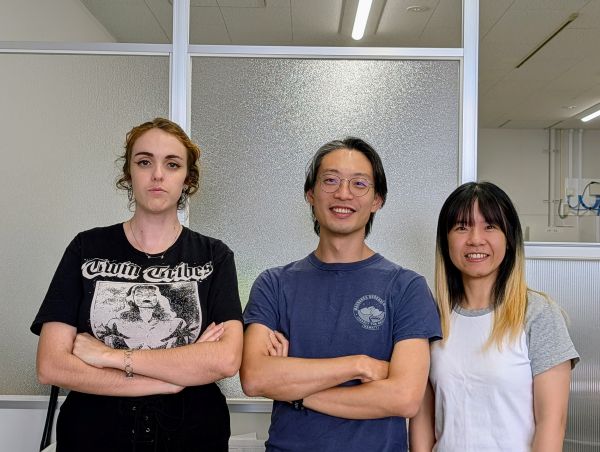
From left: Judit Ferrer Asensio, Yao-Lun Yang, Shaoshan Zeng
Recent observations with the Atacama Large Millimeter/submillimeter Array (ALMA) in Chile—an international telescope in which Japan plays a major role through the National Astronomical Observatory of Japan—have revealed that young stars are surrounded by a rich variety of complex molecules. These chemical environments may influence the composition of emerging planetary systems and shed light on the origins of organic chemistry in our own Solar System. However, many questions remained about how this chemistry changes over time and across different stellar environments.
The COMPASS project was created to address these questions by carrying out the first uniform, large-scale chemical survey of multiple young stars.
Three RIKEN researchers played key roles in the collaboration. Yao-Lun Yang helped with the planning and execution of the observing programs, especially in selecting suitable targets and the development of data-processing methods.
Meanwhile, Shaoshan Zeng and Judit Ferrer Asensio led studies on the deuteration of nitrogen- and oxygen-bearing organic molecules, a process that allows us to pinpoint when these complex species were formed along the evolution of these forming stars.
Among COMPASS’s discoveries were the detection of fully deuterated methanol and previously unknown methanol maser emissions in more than half of the low-mass protostars studied, suggesting these phenomena are far more common than previously believed.
For more information see the article on the ALMA telescope website.