


Jan. 27, 2026
RIKEN, Argonne National Laboratory, Fujitsu, and NVIDIA collaborate to advance AI and HPC
Overview
RIKEN has concluded a Memorandum of Understanding (MoU) with Argonne National Laboratory (ANL), Fujitsu Limited (Fujitsu), and NVIDIA in the fields of artificial intelligence (AI) and high-performance computing (HPC). This partnership aims to build and utilize next-generation computing infrastructure, develop and evaluate system software and applications for science and engineering, and promote the use of advanced AI technologies for science.
This agreement is positioned within the context of strengthening collaboration in "AI for Science, a field being promoted as a national strategy in both Japan and the United States. As a result, in the areas of AI and HPC, including quantum HPC, collaboration between the two nations is expected to expand significantly beyond traditional computer science, aiming to strengthen the leadership of both Japan and the U.S. in these fields.
Scope of collaboration
In recent years, advances in AI technologies have gone beyond their evolution as mere tools and are now expected to fundamentally transform the way that scientific research itself is performed. By leveraging generative models and large-scale AI foundation models in science, it will be possible to significantly accelerate the resolution of scientific challenges that previously required years to address. This impact spans diverse fields such as life sciences, materials science, environmental and climate research, and quantum computing. Furthermore, it offers the possibility of redesigning the process of knowledge discovery. In this context, the development of next-generation computing infrastructure has become indispensable for advancing AI for Science.
RIKEN and ANL previously signed an MoU on AI for Science in April 2024.In addition, towards the next-generation successor to the current supercomputer Fugaku, RIKEN is currently collaborating with Fujitsu and NVIDIA on the development of Japan’s new flagship supercomputer (development codename: "FugakuNEXT"). In November 2025, the "Genesis Mission" executive order was issued in the United States, with the aim to build AI platforms and strengthen research and development of advanced technologies through these platforms. Under this latest MoU, the parties will further advance their existing cooperation while aligning their efforts with the vision of the Genesis Mission.
Based on this MoU, the four organizations will advance cooperation in areas of mutual interest. Proposed collaborative initiatives, centered on AI, include joint research on next-generation computing architectures in advanced HPC fields, the development of open software ecosystems, the enhancement of automated experimental workflows through AI and robotics, and the integration of quantum computing with AI supercomputers. To achieve these objectives, the four organizations plan to hold joint meetings and workshops, participate in standardization efforts to build robust ecosystems, and engage with the scientific community and the public.
Examples of areas of cooperation include:
- Future HPC & AI architectures:
- Defining and prototyping next-generation compute architectures optimized for tightly coupled modeling, simulation, and AI workloads.
- Integrated HPC systems & platforms:
- Development and validation of full system designs that seamlessly integrate hardware, system software, and facility considerations.
- Shared software ecosystem for AI-enabled science:
- Build a shared, open, and interoperable software stack that enables AI for Science at scale.
- Flagship AI for Science applications & use-case demonstrators:
- Demonstrate impact through jointly selected, high-value scientific applications that drive system and software requirements.
- Laboratory experiment automation via AI-driven laboratory robots:
- Advance the integration of AI and physical science by developing autonomous laboratory workflows.
- Accelerated quantum supercomputing & integration:
- Advance the convergence of quantum computing and AI supercomputing to realize utility-scale capabilities.
Comments from the organizations
Makoto Gonokami, RIKEN President
RIKEN will lead global efforts in advancing sophisticated use of AI technologies for scientific research through this four-party agreement with Argonne National Laboratory, Fujitsu, and NVIDIA within the framework of Japan-U.S. cooperation aligned with the U.S. DOE’s Genesis Mission. Based on the agreement, we will vigorously promote the exploration of next-generation computing architectures, the development of open software environments, the automation of experimental workflows using AI and robotics, and the integration of quantum computing with AI supercomputers. Through our AI for Science initiative powered by the integration of HPC, AI, and quantum technologies, we will pursue the transformation of science and the resolution of global-scale challenges.
Paul Kearns, Laboratory Director, Argonne National Laboratory
This collaboration represents a pivotal step forward in harnessing the transformative potential of AI and high-performance computing to address pressing scientific challenges in energy, national security, and fundamental research. Together we’re building a foundation for next-generation computing architectures and AI-driven scientific discovery that advances the Genesis Mission goals.
Vivek Mahajan, Corporate Executive Officer, Corporate Vice President, CTO, in charge of System Platform, Head of Technology Strategy Unit, Fujitsu Limited
We are honored to have signed this cooperation agreement with RIKEN, Argonne National Laboratory, and NVIDIA in the fields of AI and high-performance computing (HPC). Fujitsu possesses a wide range of technologies including the supercomputer Fugaku, innovative processor technologies such as FUJITSU-MONAKA and FUJITSU-MONAKA-X, as well as world leading quantum computing hardware and software. Fujitsu is committed to applying this deep expertise towards innovating the next-generation of computing infrastructure through this highly significant international collaboration and realizing a more sustainable world.
Ian Buck, Vice President of Hyperscale and HPC at NVIDIA
AI for Science is redefining how discovery happens, transforming experiments and simulations into continuously learning systems. This U.S.-Japanese collaboration with industry is an important opportunity to accelerate discovery, and demonstrates the powerful impact of combining advanced AI, high-performance computing, next-generation computing platform development, and quantum technologies with open innovation. Together, we are making progress across fields such as materials science, drug discovery, and energy research-empowering scientists to tackle challenges that were once beyond reach.
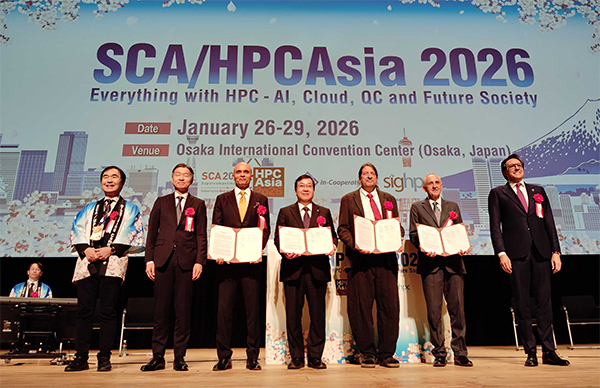
From left: RIKEN R-CCS Director Satoshi Matsuoka; Senior Deputy Minister of Education, Culture, Sports, Science and Technology Yasuyoshi Kakita; Corporate Executive Officer, Corporate Vice President, CTO, in charge of System Platform, Fujitsu Limited Vivek Mahajan; RIKEN President Makoto Gonokami; Argonne Associate Laboratory Director Rick Stevens; Vice President, Global Sales and Business Development for HPC/AI/Supercomputing, NVIDIA Corporation John Josephakis; Under Secretary for Science, U.S. Department of Energy(DOE) Darío Gil
Contact information
Computational Science Promotion Division (Outreach Group), RIKEN
Email: r-ccs-koho@ml.riken.jp
Communications Division (Media Relations Section), RIKEN
Contact form